» Home » Blog » Boardroom Resilience Amid the Iran and US War
Boardroom Resilience Amid the Iran and US War
Executive TLDR: Intensifying conflict between Iran and the United States is not just a geopolitical headline— it is a board-level stress test that forces CEOs and their teams to rebalance…
By pythonapiuser@gmail.com
08. 05. 20267 minutes
Executive TLDR: Intensifying conflict between Iran and the United States is not just a geopolitical headline— it is a board-level stress test that forces CEOs and their teams to rebalance capital, talent, and technology toward resilience. Leaders that embed scenario-led planning, multi-tier visibility, and AI-enabled response mechanisms now will protect growth ambitions and mitigate the tragic Life Loss in wars ripple effects across economies and supply chains.
War-Fueled Boardroom Dilemmas
Wars traditionally felt distant from quarterly earnings discussions. Today, the Iran and US War has collapsed that distance. Boardrooms confront slower global growth, volatile energy costs, and sudden cyber escalation while investors demand proof of operational continuity. The humanitarian dimension—Life Loss in wars and mass displacement—raises reputational scrutiny, requiring leaders to weigh profitability against broader societal impact. The core tension: how to safeguard near-term performance while funding long-term resilience.
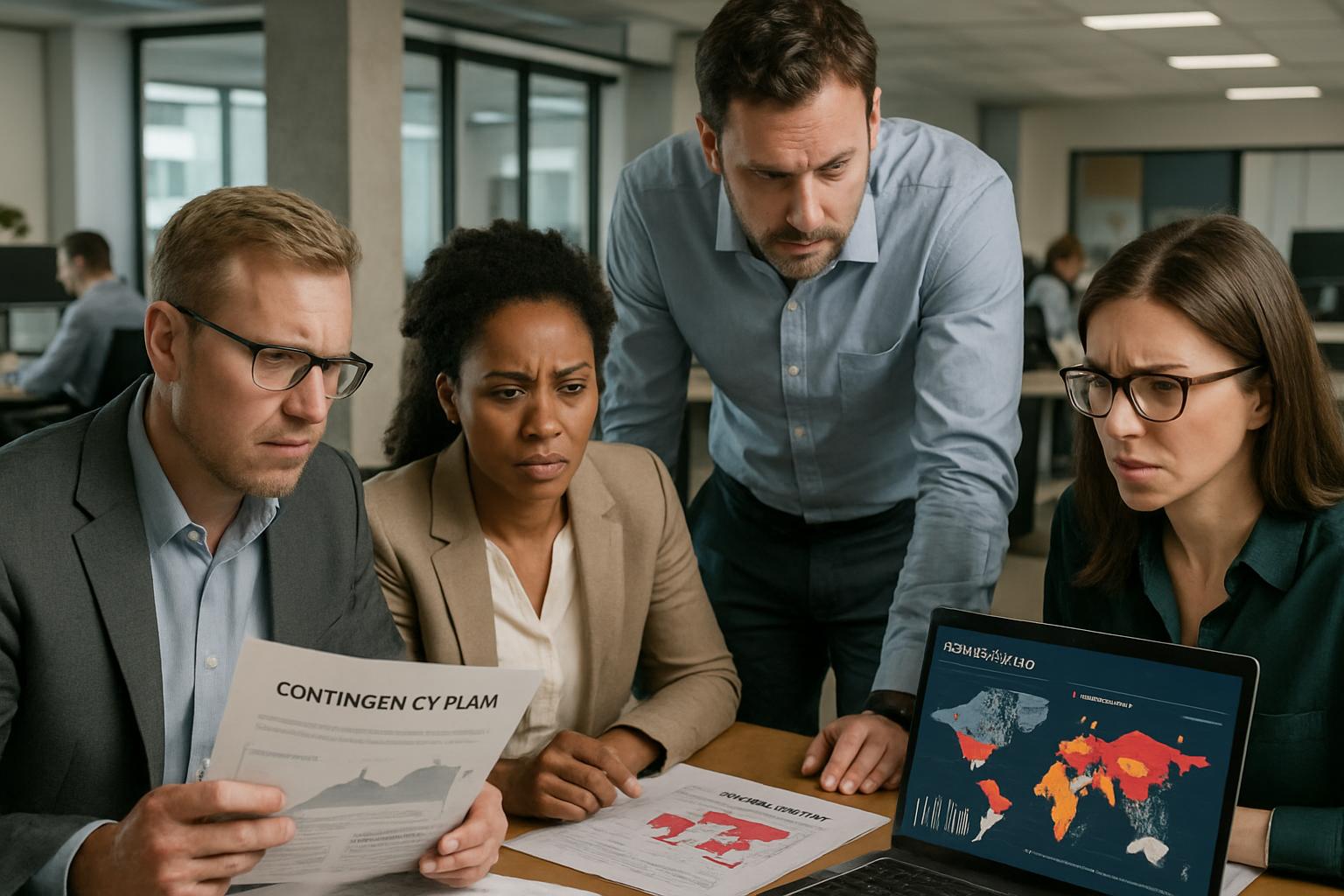
Operational teams coordinate workflows to ensure business continuity despite uncertainties from the Iran and US War.
Iran and US War: Misconceptions
Many executives still frame conflict risk as a binary “on/off” disruption—tankers either move through the Strait of Hormuz or they do not. Reality is graduated and systemic:
1. Economic impact is nonlinear. IMF modelling shows a 0.6 percentage-point global growth hit in an adverse scenario, but firm-level exposure ranges from negligible to existential depending on supply-chain concentration.
2. Cyber and physical threats converge. Microsoft’s digital defense data reveal opportunistic criminal actors piggybacking on state campaigns, so the threat surface widens beyond critical infrastructure to everyday enterprise SaaS.
3. Resilience is not cost-prohibitive. McKinsey benchmarks indicate that selective diversification and AI-based forecasting can yield positive risk-adjusted ROI when compared to multi-month shutdown costs.
Why Leaders Must Act
Conflicts reshape the enterprise value equation in three material ways:
Capital Allocation. Rising energy prices and defense-related fiscal shifts inflate operating expenses and borrowing costs, squeezing discretionary growth investment. CFOs must integrate volatile commodity inputs and sovereign risk premiums into hurdle rates.
Talent & Workforce. UNHCR reports millions displaced by regional conflict, pressuring talent pipelines and local social services. CHROs face both labour shortages and heightened duty-of-care obligations.
Customer Expectation. Stakeholders reward ethical resilience. Consumers and investors increasingly price in how firms respond to humanitarian fallout, including Life Loss in wars, when allocating spend or capital.
From Intent to Action
Progressive enterprises translate strategic intent into four execution layers:
1. Scenario Economics. Finance teams run tri-modal (baseline, moderate, adverse) models on demand, cash, and FX exposures.
2. Multi-Tier Visibility. Operations leaders use graph-based supplier maps and AI-driven risk scoring to illuminate dependencies beyond tier-1.
3. Hybrid Resilience Playbooks. CISOs and COOs co-design joint cyber-physical response workflows, tested every quarter via tabletop exercises.
4. Governance & Incentives. Boards link executive compensation to resilience KPIs—time-to-recovery, concentration index reduction, and scenario readiness scores.
Critical Execution Gaps Exposed
Yet surveys show only a minority achieve integrated resilience. Typical pitfalls include:
Spreadsheet Stress Testing. Treasury teams rely on static models that ignore cascading logistics delays or secondary sanctions impacts.
Shallow Supplier Audits. Procurement maps stop at direct vendors, missing the refinery two tiers back that sits inside the conflict zone.
Tooling–Talent Mismatch. AI platforms get procured, but data remains siloed in legacy ERPs, and analysts lack the upskilling to interpret probabilistic outputs.
Boardroom Myopia. Resilience is treated as an insurance policy, not as a growth enabler, leading to under-funded mitigation projects.
Board-Level Resilience Framework
Advising clients, we deploy a “4R” framework that integrates strategic and operational levers:
1. Re-Assess Exposure. Quantify revenue, cost, and cash-flow sensitivity to energy, logistics, and cyber variables across scenarios.
2. Rewire Supply. Pursue friend-shoring, dual-sourcing, and strategic stock for high-impact inputs; model trade-off between cost and risk using marginal VaR.
3. Reinforce Cyber. Align IT and OT security baselines, elevate threat-hunting for state-grade techniques, and extend zero-trust to third-party integrations.
4. Reinvest in Talent. Cross-train planners in data science, incentivize resilience upskilling, and embed humanitarian literacy to navigate Life Loss in wars responsibly.
Enterprise Scenario in Practice
Problem. A global consumer-goods firm sourcing 40% of its petrochemical feedstock via the Strait of Hormuz faced a 25% spot price spike and rising cyber probes after the first week of the Iran and US War escalation.
Action. The COO activated a pre-defined contingency: AI-assisted dashboards pulled live AIS vessel data, rerouted shipments to alternative ports, and triggered a hedge overlay in treasury. Simultaneously, the CISO elevated threat posture, blocking anomalous traffic tied to conflict-linked IP ranges.
Outcome. Production ran at 92% of plan versus a 70% sector median; profit impact was limited to 80 basis points, and the firm issued a transparent stakeholder report acknowledging regional Life Loss in wars and outlining continued humanitarian donations—earning positive investor feedback.
The Emerging Geostrategic Outlook
The macro signals point toward sustained fragmentation:
• Energy Volatility. IEA tracks the largest coordinated oil disruption in modern history; price whiplash will remain a boardroom constant.
• Re-globalization. Supply chains are rewiring, creating regional clusters that embed security premiums into cost structures.
• Automated Resilience. Gartner forecasts 60% of supply-chain disruptions to be resolved without human intervention by 2031 as AI maturity accelerates.
Leaders who institutionalize resilience now can convert uncertainty into competitive edge, while those delaying risk prolonged recovery and reputational damage.
Key Leadership Imperatives Ahead
Geopolitical shocks will not abate. The Iran and US War simply crystallizes a new normal where conflict, inflation, and cyber threats intertwine. Boards must fund resilience as a core strategic asset, not a discretionary expense. The organizations that thrive will operationalize the 4R framework, align incentives with resilience KPIs, and harness AI for anticipatory response—ultimately safeguarding stakeholders and limiting the human and economic toll of Life Loss in wars.
Executive Leadership FAQ Section
Q1: How often should we update war-related scenarios? At least quarterly, with ad-hoc refreshes when intelligence indicates material escalation or new sanctions.
Q2: What KPI best signals supply-chain concentration risk? A weighted supplier concentration index that factors spend, geographic overlap, and criticality provides a clear single metric.
Q3: Where does AI deliver fastest resilience ROI? Demand forecasting and dynamic inventory optimisation typically show payback in under 18 months due to immediate working-capital benefits.
Q4: How do we balance ethics with shareholder value during conflict? Embed humanitarian impact metrics into board dashboards and link executive bonuses to both financial and social resilience outcomes.
Q5: Is cyber insurance sufficient against hybrid attacks? No. Coverage is narrowing; proactive zero-trust, regular red-teaming, and supplier security clauses remain essential.
Frequently Asked Questions
How can leaders effectively integrate scenario-led planning to mitigate operational disruptions from geopolitical conflicts? Leaders should develop multiple risk scenarios—baseline, moderate, and adverse—to gauge the impact on cash flow, supply chains, and energy costs. Integrating AI-driven analytics with traditional models enables proactive adjustments in capital allocation and operational planning, effectively mitigating disruptions and ensuring both growth stability and resilience under volatile conditions.
What is the strategic ROI of investing in AI-driven supply chain visibility during geopolitical unrest? Investing in AI-driven supply chain visibility delivers measurable ROI by accelerating threat detection and optimizing resource allocation. Enhanced multi-tier mapping of suppliers and risk scoring reduces downtime and cost overruns, converts uncertainty into competitive advantage, and offers critical insights that help maintain operational continuity during periods of geopolitical instability.
How should boards balance short-term profitability with long-term resilience investments amid conflict-induced volatility? Boards need to integrate resilience metrics, such as time-to-recovery and supplier concentration indices, into compensation and performance reviews. By embedding scenario-based stress testing and aligning capital allocation with risk management frameworks, executives can balance short-term earnings pressures with necessary long-term investments, ensuring sustained growth and adaptability during periods of volatility.
In what ways can enterprises address workforce challenges resulting from conflict-driven talent shortages and humanitarian pressures? Enterprises must proactively upskill talent and realign HR strategies to manage labor shortages and broader societal impacts. Cross-training in areas like data science and resilience, along with adopting flexible workforce models, ensures that organizations can navigate talent disruptions while maintaining operational continuity and addressing the increased duty-of-care in crisis situations.
How do proactive cybersecurity measures augment enterprise resilience during escalating hybrid threats in conflict zones? Proactive cybersecurity measures, including zero-trust frameworks, continuous red-teaming, and enhanced threat-hunting, are essential in mitigating risks from hybrid cyber-physical attacks. These strategies reinforce overall operational resilience by reducing exposure to breaches, ensuring the security of both critical infrastructure and everyday digital operations amid dynamic threat landscapes.
Continue Reading
For more insights and related articles, check out:
Executive TLDR: India’s increasingly erratic Summer and Winter seasons have moved from operational headache to balance-sheet risk. Boards that translate…