The Future of Leadership in the AI Era: Skills Every Executive Must Develop
Artificial intelligence is transforming the way organizations operate, making AI leadership an essential skill for today's executives. Discover the key leadership abilities needed to navigate change, empower teams, and lead…
By Krisha Bhanushali
14. 05. 20267 minutes
Artificial intelligence is no longer a future consideration for business leaders. It is already reshaping how companies operate, how decisions get made, and how teams work together. From automated data analysis to AI-assisted forecasting, executives across every industry are being asked to lead in an environment that looks fundamentally different from the one they trained for.
This is a topic we return to often at Sarder TV, where we speak directly with Fortune 1000 CEOs, bestselling authors, and academic leaders about how they are navigating exactly this kind of change. Across those conversations, one theme keeps surfacing: AI leadership is becoming a defining priority for organizations everywhere, and executives who ignore it do so at their own risk.
AI leadership is not simply about understanding algorithms or adopting new software. It is about guiding people, strategy, and culture through a period of rapid technological change. And for today’s executives, developing this capability is quickly becoming as important as any traditional management skill.
Why Traditional Leadership Is no Longer Enough
For decades, strong leadership was built on experience, hierarchy, and steady decision-making. Those qualities still matter, but they are no longer sufficient on their own. AI has introduced a pace of change that traditional leadership models were not designed to handle.
Executives are now expected to make decisions using real-time data, understand the capabilities and limitations of AI tools, and communicate confidently about technology they may not have grown up with. Leadership in AI requires a mindset shift: from directing based on experience to leading through continuous learning and adaptation.
This does not mean that older leadership principles are obsolete. It means they need to be paired with new capabilities that reflect how business actually runs today.
The Impact on Organizations and Employees
AI transformation touches nearly every part of a business, and its effects reach far beyond the IT department. Teams are restructuring around new workflows. Decision-making is becoming faster and more data driven. Roles are shifting as repetitive tasks get automated, and employees are asked to focus more on judgment, creativity, and strategy.
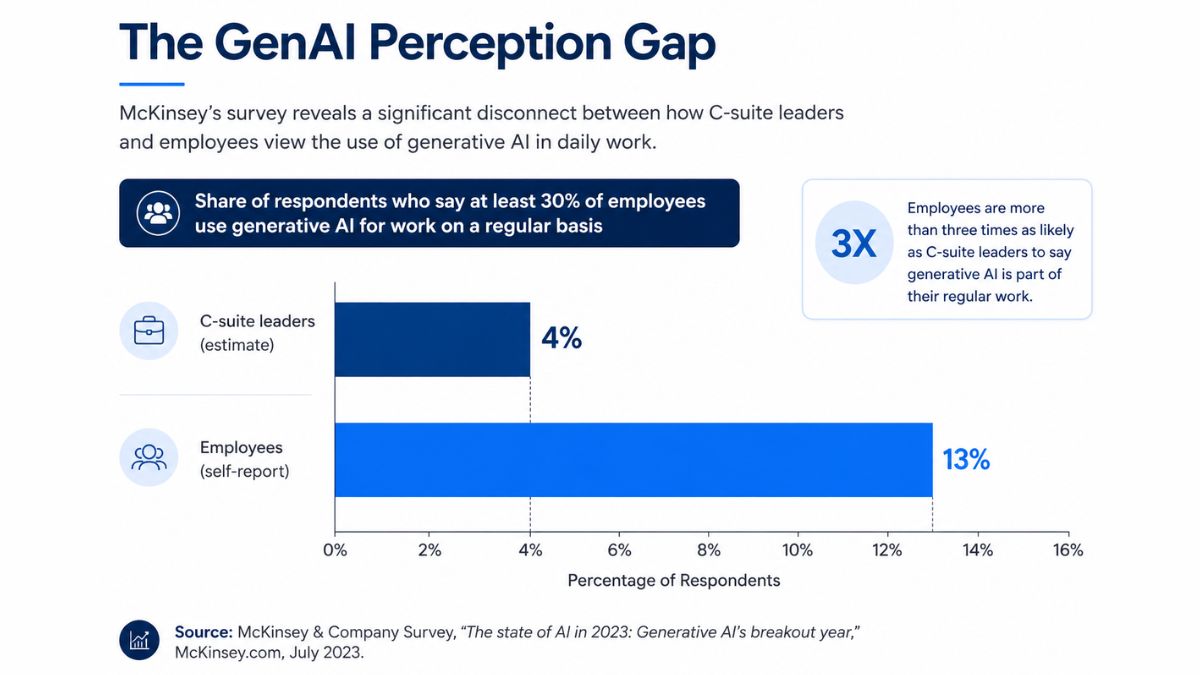
For employees, this can create real uncertainty. Many workers are unsure how AI will affect their jobs, their skills, or their career paths. Some are experimenting with AI tools on their own, often faster than their organizations are prepared to support. In fact, a McKinsey survey found that C-suite leaders estimate only about 4 percent of employees use generative AI for at least 30 percent of their daily work, while employees themselves report a figure more than three times higher, at 13 percent. That gap between perception and reality reflects a leadership blind spot that can leave organizations unprepared as AI reshapes workflows faster than expected.
Executives who ignore this uncertainty risk lower morale and disengagement. Executives who address it directly, with honesty and a clear plan, build trust during a time when trust matters most. This is where executive leadership plays its most important role: not just approving AI initiatives but helping people understand and adapt to them.
Key Skills Every Executive Must Develop
As AI becomes embedded in daily operations, certain skills are becoming essential for leaders who want to stay effective. These include:
AI literacy. Executives do not need to become data scientists, but they do need a working understanding of what AI can and cannot do. This allows them to ask the right questions, evaluate proposals critically, and avoid both overreliance and unnecessary hesitation.
Adaptability. The tools, platforms, and best practices around AI are evolving constantly. Leaders who can adjust their approach as new information emerges will consistently outperform those who rely on a single fixed strategy.
Strategic thinking. AI generates enormous amounts of data and possibility. The real value comes from leaders who can connect that information to long-term business goals, rather than chasing every new capability that appears.
Emotional intelligence. As automation changes team structures, leaders need to read how people are responding, address concerns before they grow, and keep employees engaged through change.
Communication. Explaining complex AI initiatives in clear, honest terms is a skill on its own. Leaders who communicate well reduce confusion and resistance across their organizations.
Ethical decision-making. As AI takes on a larger role in decisions that affect customers and employees, leaders must ensure those decisions remain fair, transparent, and aligned with company values.
Together, these skills form the foundation of leadership in AI: not just technical fluency, but the judgment to apply it responsibly.
Balancing Technology with Human Skills
One of the most important truths about AI leadership is one that gets overlooked in the excitement around new tools: AI will not replace leadership. It will change what leadership looks like, but the core of the role, guiding people, will remain deeply human.
Executives who lean too heavily on technology and neglect human connection often see the impact in employee trust and retention. The most effective leaders treat AI as a tool that supports their judgment, not a substitute for it. They continue to prioritize empathy, build trust across their teams, and make room for collaboration, even as processes become more automated.
In practice, this means using AI to remove friction and free up time, then reinvesting that time into the conversations, mentorship, and relationship-building that machines cannot replicate. The leaders who get this balance right tend to have organizations where people feel supported by technology rather than replaced by it.
A Look at the Future of Work
The future of work will continue to be shaped by AI adoption, and the pace of change is unlikely to slow down. Organizations will keep restructuring roles, workflows will keep evolving, and employees will keep needing support as their day-to-day responsibilities shift.
Leaders who prepare now, by building AI literacy, staying adaptable, and keeping people at the center of their strategy, will be far better positioned than those who wait for change to force their hand. Executive leadership in the years ahead will be defined less by who adopts AI first, and more by who integrates it thoughtfully, with their teams and long-term goals in mind.
Organizations that invest early in leadership development around AI are also more likely to retain talent, since employees increasingly expect their leaders to guide them through this transition rather than leave them to navigate it alone.
The Path Forward for Leaders
The future of leadership in the AI era is not about choosing between technology and people. It is about developing the skills to lead both effectively. Executives who commit to continuous learning, build genuine AI literacy, and stay grounded in human-centered leadership will be the ones who guide their organizations successfully through this transformation.
The leaders who thrive will not be the ones with the most advanced tools. They will be the ones who know how to use those tools while never losing sight of the people they lead.
If you want to keep learning from leaders who are already putting these skills into practice, visit Sarder TV, your premier business media platform for growth, and explore interviews with the executives shaping the future of leadership.
Frequently Asked Questions
What is AI leadership?
AI leadership refers to the ability of executives to guide people, strategy, and culture through the changes brought on by artificial intelligence. It combines a working knowledge of AI tools with traditional leadership skills like communication, judgment, and emotional intelligence.
Will AI replace executive leadership roles?
No. AI can support decision-making and automate repetitive tasks, but it cannot replace the human judgment, empathy, and trust-building that effective leadershiprequires. AI is changing what leadership looks like, not eliminating the need for it.
What skills do executives need most in the AI era?
The most important skills include AI literacy, adaptability, strategic thinking, emotional intelligence, communication, and ethical decision-making. Together, these skills help executives apply AI responsibly while keeping their teams engaged.
How is AI transformation affecting employees, not just executives?
AI transformation is reshaping workflows, team structures, and daily tasks across organizations. Employees often adopt AI tools faster than leadership expects, which makes clear communication and support from executives essential during the transition.
How can executives prepare for the future of work in an AI-driven environment?
Executives can prepare by committing to continuous learning, building AI literacy, and keeping people at the center of their strategy. Leaders who prepare early tend toretain talent and adapt more smoothly as AI adoption continues to grow.
Artificial intelligence is transforming the way organizations operate, making AI leadership an essential skill for today's executives. Discover the key…
Artificial intelligence is transforming the way organizations operate, making AI leadership an essential skill for today's executives. Discover the key…
Artificial intelligence is transforming the way organizations operate, making AI leadership an essential skill for today's executives. Discover the key…
Artificial intelligence is transforming the way organizations operate, making AI leadership an essential skill for today's executives. Discover the key…